Beautiful chaos


By Erik Hogan
Change comes suddenly with late September rain. Clouds and cool weather. The brutish heat of summer spilling carelessly into autumn is finally, thankfully, driven into remission. The seasons have found a pivot, but the atmosphere is attended by vague heaviness. A somber recognition of the brevity of autumn already slipping past as life continues to careen wildly down its tracks.
In the early morning an owl calls from a tree at the edge of the yard, in the darkness beyond the limits of vision. A commentary on deadlifts and kettlebells before dawn. I call back. Not a rebuttal, nor a question. Just a hope for connection with a confidante under slowly fading stars. Silence. And a chill on the skin as the sweat dries.
As the seasons inevitably change, so people also come to pivot points. While this is a natural part of growth and evolution through phases of life, there is still a significant accompaniment of melancholy and trepidation in a turn from the familiar.
On a crisp clear morning against a paling sky a murmuration of starlings flows above the treetops. Ebbing and surging like a course of water through the air. Mesmerized by the motion, in some unexplainable way, my pivot point becomes undeniable.
Photography is not the way. It will not lead me to the destinations I had hoped for. Its a tough realization, but I have to stop devoting resources and time to it as if it were a business. I finally understand that I will not work my way up, get discovered, or build anything lasting with it.
The world itself is changing rapidly. Cameras are ubiquitous in every person’s pocket. Digital images flood cyberspace like an ocean surging through burst levies. Artificial intelligence not only generates its own digital images now, but it is also rapidly becoming integrated as part of the photo editing process.
Becoming skillful at a computer program, at manipulating pixels for screens and the internet, was never the goal.
This late in September the lower angle of the sun becomes discernable in the afternoons, lighting up yellowing leaves in the canopy with a warm glow. Crickets buzz in the tall grass and camphorweed is blooming. This is autumn. This moment holds value, yet demands a level of presence to absorb it before it slips away.
Photography, writing, the whole endeavor of relaying adventures in the wild, has shifted since its inception from an effort towards building an income from enjoyable pursuits to one of higher fulfillment through creative avenues and mindful engagement with the world. But that shift demands a very different approach.
Sam Alaimo recognizes that the struggle of creativity is an inseparable part of the process in his recent essay Why AI is Anti-human in Creative Pursuits. In fact, the struggle, or toil as he terms it, may be more important than the end result. Sam asserts that AI, with its instant effortless generation of content, essentially dissolves the process of creativity. In making creation effortless AI dissolves the entire point of it.
Yes, but this fact also gives rise to the question of how we approach any creative effort. How much technology do we involve? And what do we sacrifice of ourselves by embracing digital spaces that exist outside of the physical world?
Lou Tamposi explores answers in the essay On Trails as he exchanges writing on a computer with writing on a typewriter. It is evident from his description that the process is different. It asks more of us, or perhaps it illustrates that the computer, with its ease of error corrections, has taken something away from us.
And so, my priority has shifted away from digital photography in digital spaces. Instead, I’ve picked up a pen. And more specifically a fountain pen.
It has long been know that there is a deep and positive connection with our thoughts and the act of walking. Solvitur ambulando is a Latin term meaning “it is solved by walking.” It illustrates the uniquely human inseparable nature of mental and physical activity. I couldn’t tell you the mechanism at work. What would walking and thinking have to do with one another? Yet part of the mystery of life is that knowing the mechanism is unnecessary if it is demonstrated over time to be effective.
With this in mind, it is my assertion that there is something to be gained from keeping the act of writing a tactile proficiency. Skillful lines carefully inscribed to construct meticulously chosen words, knit into paragraphs and pages. Lou calls the process conscientious and I solidly agree. Could the physical act of writing by hand produce qualitatively different results than by typing them onto a glowing screen? I thought about this while walking, and the answer is very likely ‘yes!’
If I believe the act of physically writing words creates something qualitatively different, then the same would be true of hand drawn or painted images. The combination of the physical with the creative becomes a synergistic process; an integrative process that advances both the creator and the creation towards virtue or excellence. So, with the same pen and also with pencil, charcoal, and watercolor, I’m turning to sketching, drawing, and painting.

Life, nature, existence… its such a complex system that there will never be explanations that suffice. We can consider this the opacity of life, its ultimate unknowable nature. Time, then, becomes an ultimate test of fragility. And if we combine the unknown with accelerated time we come to the rapidly evolving nature of chaos.
Chaos is inherently frightening, so as we become familiar with certain paths we tend to stick to them. We stay with the familiar because it works, sort of, even if it does not lead to the best destination. All because we try to avoid the unknown.
The counterintuitive element, however, is that chaos carries energy and creativity requires energy. So, perhaps we can learn to harness the energy of chaos and transform it into art or engaging writing? When we set fear aside and start something new we do so with the imaginative potential of the beginner’s mind.
Starting on a new path, it is important to remember that it is not starting from nothing. Years of photography has trained me to see the light, to look beyond the surface of what is in front of me, to compose a scene, to consider contrast and color and how they relate to experience through the visual image. All of this can eventually translate into drawing, painting, and even be relayed by words artfully written on a page. This translation of skills from one genre to another is the goal. As the legendary swordsman Miyamoto Musashi so famously said, “if you know the way broadly, you will see it in everything.”
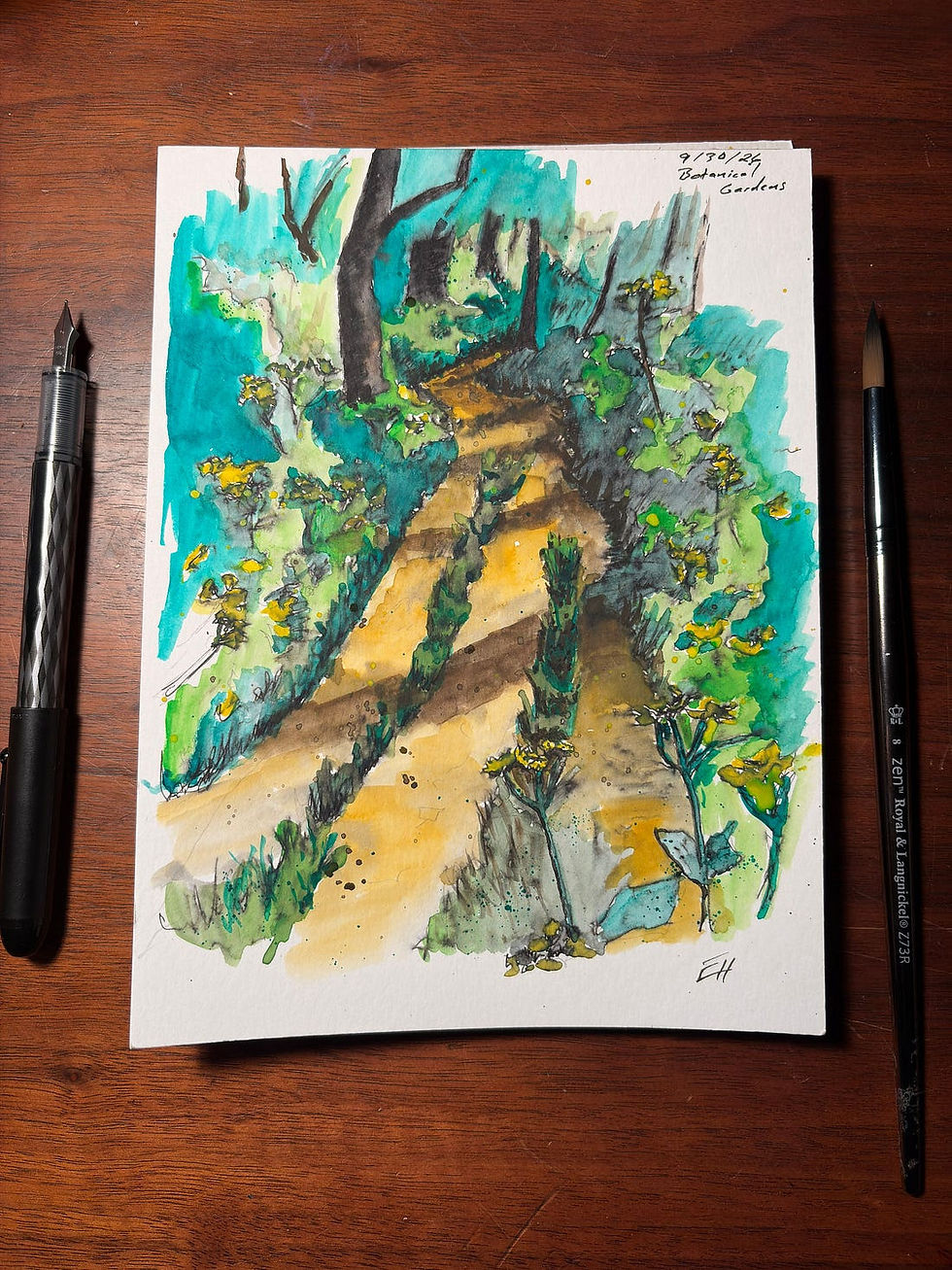

Late morning grows hot on the trail by the Middle Oconee River at the State Botanical Gardens of Georgia. Yellow ironweed erupts along the sides of the path and birds chirp from hidden perches in the shrubbery. It is an interesting scene that I sit to draw.
When the sweat begins to roll down my brow it is time to wander on. At home later I attempt to paint the sketch with watercolor. My first attempt in that medium. The painting is a hot mess, and I quickly learn that the ink I sketched with is not waterproof. All of my drawings at this stage are hot messes, in fact. But it is such beautiful chaos!
In the face of a world rushing towards living existentially online and with AI integration into everything, Sam states “The creative act is now an act of rebellion.” So perhaps this is what I am describing to you here. A rebellious act of stepping away from the familiar and away from what you’ve come to expect from me, with the full terrifying knowledge that my creations will be very bad for a very long time.
This is my effort to push away the immaterial online dream world we are all actively being herded towards and create something incarnate. Although the road ahead is long and uncertain, I trust myself to figure it out. Faced with the unknowable nature of life, there are times when it is valid to be guided by intuition with the guardrails of doubt. Time will tell. If this path works I do not need to know why to know that it is rational.
Its the process of improving that is the point. I’ll practice and hone the craft and get better over time. Eventually I’ll figure out how to take this process of drawing and painting into the wild on backpacking trips. And hopefully along the way, I’ll develop some mindfulness and insights to apply broadly.
The season is turning and I’m appreciating presence in this moment. Perhaps that’s a story worth sharing.
Erik Hogan is an Athens police officer whose photography focuses on capturing the beauty of nature.